
RESEARCH TRIANGLE PARK, N.C. — Opus Genetics, Inc. (Nasdaq: IRD) (“Opus Genetics” or the “Company”), a clinical-stage biopharmaceutical company developing gene therapies to restore vision and prevent blindness in patients with inherited retinal diseases (IRDs), today announced the completion of enrollment in Cohort 1 of its ongoing Phase 1/2 study of OPGx-BEST1 gene therapy.
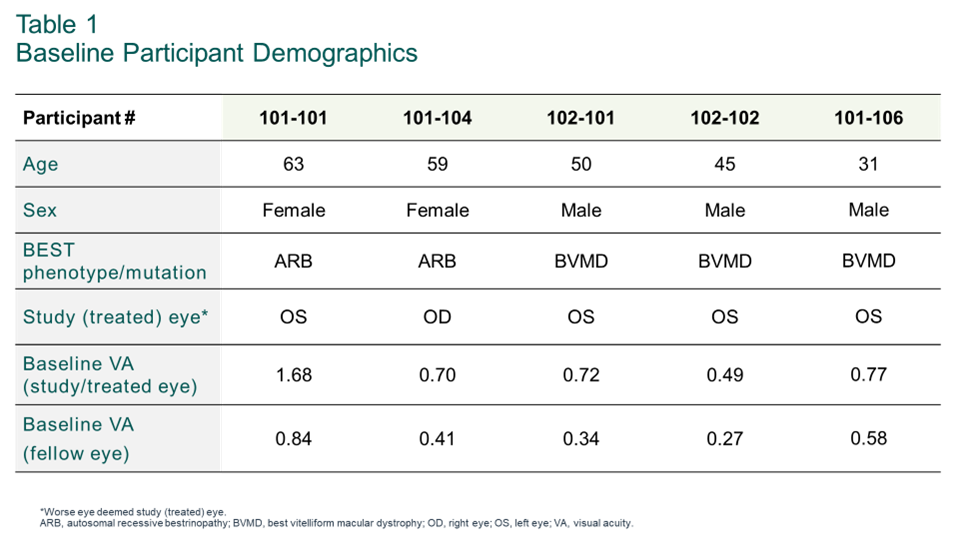
The adaptive, open-label study is evaluating the safety and efficacy of single-eye subretinal administration of OPGx-BEST1 up to two dose levels in adult participants with Best Vitelliform Macular Dystrophy (BVMD) or Autosomal-Recessive Bestrophinopathy (ARB). Five participants have been enrolled in the study, three with BVMD and two with ARB. The first four participants have been dosed and the fifth participant is scheduled for the dosing procedure this month.
“As planned, we enrolled a mix of participants with the dominant and recessive forms of BEST disease to evaluate OPGx-BEST1 in both conditions,” said George Magrath, M.D., Chief Executive Officer, Opus Genetics. “We collaborated closely with our study sites and investigators to identify participants who met our carefully defined entry criteria. In the dominant participants, we completed the added step of using an in vitro platform to confirm that each participant’s disease mutation is amenable to gene augmentation. The promising tolerability data and early efficacy signals we saw in the sentinel participant show the promise for individuals living with this potentially blinding disease. We are grateful to the participants and clinical sites who are participating in the trial, and we look forward to presenting the three-month data on the full cohort later this year.”
In a session today at the Association for Research in Vision and Ophthalmology (ARVO) Annual Meeting, the study’s principal investigator, Mark Pennesi, M.D., Ph.D., Chief Medical Officer and Director, Inherited Retinal Degeneration Clinic, Retina Foundation of the Southwest, presented baseline demographics of Cohort 1 (summarized in Table 1) and 3-month results from the first (sentinel) participant treated in the study, highlighting positive tolerability and biological activity following subretinal administration of OPGx-BEST1.
The ARVO poster presentation and a video recording of Dr. Pennesi’s summary of Cohort 1 Baseline Demographics and Key Endpoints for IRDs are available on the Opus Genetics website in the Events section.
Opus expects to announce 3-month topline data from Cohort 1 in September 2026, followed by the presentation of data at an ophthalmology medical conference later this year. Data is expected to be provided on multiple outcome measures including structural optical coherence tomography (OCT) measures, microperimetry, best‑corrected visual acuity, low luminance visual acuity and contrast sensitivity.
About OPGx-BEST1
OPGx-BEST1 leverages Opus Genetics’ proprietary AAV-based gene therapy platform, designed to deliver a functional copy of the BEST1 gene directly to the retinal pigment epithelium (RPE) cells where the defective gene resides. The program builds on extensive preclinical work demonstrating restoration of BEST1 protein expression and improved retinal function in relevant disease models.
By restoring BEST1 function, the therapy aims to address the underlying genetic cause of retinal degeneration and support preservation of photoreceptor health and visual function. BEST1-associated IRDs affect an estimated 22,000 patients worldwide and currently have no approved treatments.
About Opus Genetics
Opus Genetics is a clinical-stage biopharmaceutical company developing gene therapies to restore vision and prevent blindness in patients with inherited retinal diseases (IRDs). The Company is developing durable, one-time treatments designed to address the underlying genetic causes of severe retinal disorders. The Company’s pipeline includes seven AAV-based programs, led by OPGx-LCA5 for LCA5-related mutations and OPGx-BEST1 for BEST1-related retinal degeneration, with additional candidates targeting RDH12, MERTK, RHO, CNGB1 and NMNAT1. Opus Genetics is based in Research Triangle Park, NC. For more information, visit www.opusgtx.com.
Investors Contact
Jenny Kobin
Remy Bernarda
IR Advisory Solutions
[email protected]
Media Contact
Kimberly Ha
KKH Advisors
917-291-5744
[email protected]